Why Enterprise AI Application Platforms Should Be Self-Hosted First
Once AI reads business data, triggers workflows, generates applications, and calls tools, enterprises need control over the runtime that governs objects, permissions, tools, approvals, and audit evidence.
When enterprises adopt AI, it is easy to focus on model capability: context window, reasoning quality, latency, and generation speed.
But once AI moves beyond chat and starts reading customers, orders, contracts, tickets, approvals, and internal files, the more important questions become:
Where does this data run? Who can access it? Where are logs written? Who controls keys? Who can stop the system when something goes wrong?
That is why self-hosted AI application platforms matter.
The first thing to self-host is not always the model. It is the AI application runtime.
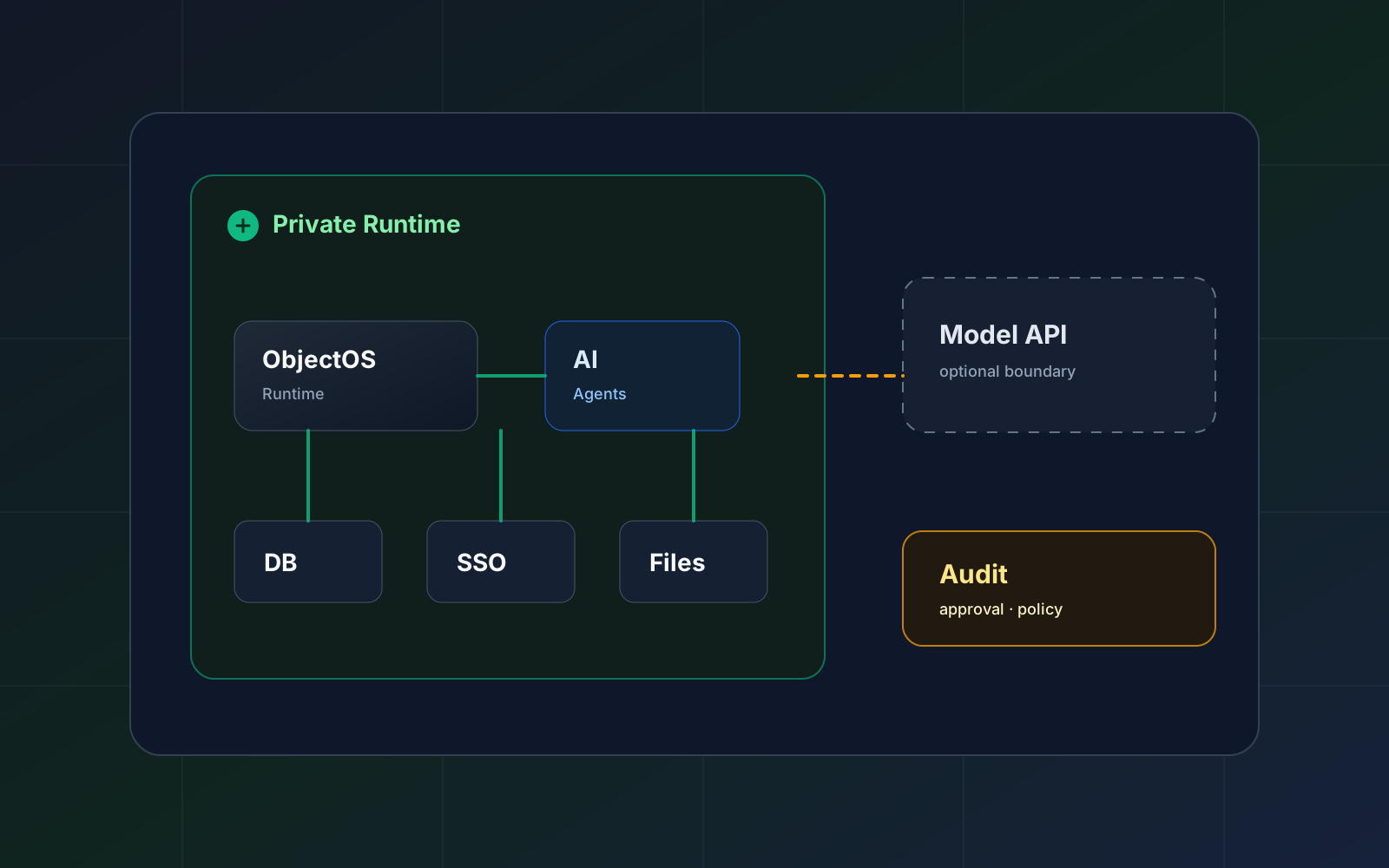
Models can be external or local. The runtime that holds business objects, permissions, workflows, agent tools, and audit evidence should run in infrastructure the enterprise controls. The model reasons; the runtime decides what data can be read, what actions can be executed, what requires approval, and what evidence must be retained.
Self-Hosted Means More Than Installing Software
Some teams treat self-hosting as an installer or a private deployment option. That is only the first layer.
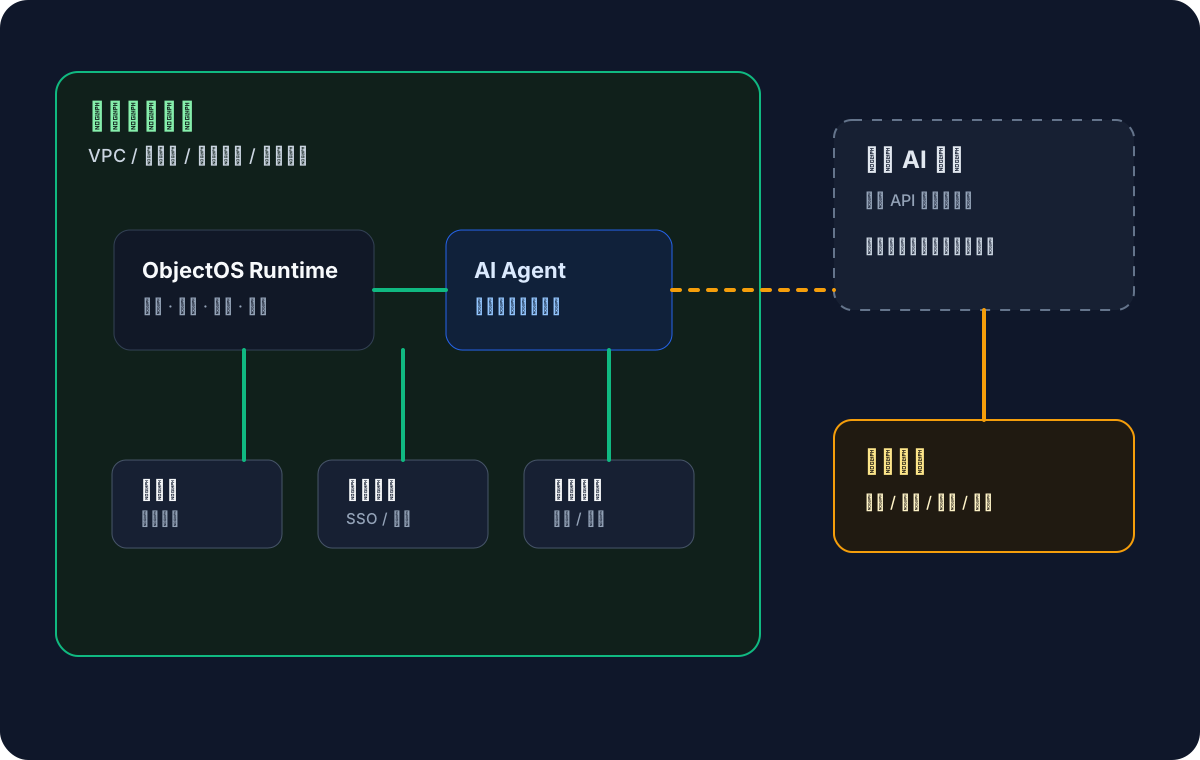
The important part is the responsibility boundary:
- business records stay in your database;
- files stay in your object storage or file system;
- identity and permissions come from your SSO, org structure, and roles;
- audit logs flow into your logging and compliance systems;
- keys, networks, backups, and access policies remain under your control;
- external model connections are explicitly configured and approved by you.
If a platform claims to be “enterprise AI” but requires every business context to be uploaded to the vendor cloud first, IT teams will struggle to answer questions about compliance, data residency, audit, and exit cost.
The value of self-hosting is not rejecting cloud or external models. It is keeping final control.
Runtime, Local Model, and Private SaaS Are Different
Three ideas often get mixed together:
Self-hosted runtime: business objects, permissions, workflows, agent tools, approvals, and audit run in infrastructure controlled by the enterprise.
Local model: model weights or inference services run inside the enterprise environment for isolation, cost, latency, or compliance reasons.
Private SaaS: a vendor provisions a dedicated environment, but operations, logs, upgrades, and data processing remain vendor-controlled.
These can be combined, but they are not the same. The first thing to verify is the runtime boundary: does business data enter your object layer first, do agents inherit your permission system, and does audit evidence land in your logging stack?
If the runtime is outside enterprise control, even a local model can still bypass business permissions. If the runtime is inside enterprise control, even an external model API can be used with only approved, minimal context.
AI Applications Need Stronger Boundaries Than Ordinary SaaS
Ordinary SaaS usually handles data for one application. An AI application platform naturally connects many systems:
- customers and opportunities in CRM;
- orders and inventory in ERP;
- service history in ticketing systems;
- contract value, terms, and approvals;
- attachments, reports, and internal files;
- users, roles, and org structure from identity systems.
Once agents can query and act across these systems, the platform becomes a business operating layer.
If that layer runs entirely outside the enterprise boundary, risk increases:
- it is hard to explain which business data went where;
- it is hard to inherit existing enterprise permissions consistently;
- it is hard to write agent behavior into internal audit systems;
- it is hard to satisfy network isolation, industry regulation, or customer contracts;
- it is hard to preserve continuity if a vendor relationship changes.
The real question is not whether AI can connect to business systems. It is whether the operating boundary remains under enterprise control after AI connects.
What the Self-Hosted Runtime Should Own
An enterprise AI application runtime should keep these capabilities inside the customer environment.
| Capability | Why it belongs in the runtime |
|---|---|
| Business object layer | Model customers, orders, tickets, contracts, and equipment as governed objects instead of letting agents guess database tables. |
| Permission layer | Inherit identity, roles, record access, and field permissions so agents work inside user boundaries. |
| Tool layer | Expose queries, actions, and workflows as controlled tools with constrained inputs and outputs. |
| Approval layer | Route risky actions to human approval instead of letting a model write directly. |
| Audit layer | Record what the agent read, recommended, called, approved, and changed. |
| Integration layer | Connect databases, ERP, CRM, identity, and files while preserving network and key control. |
With these capabilities inside the runtime, AI can approach real business systems without bypassing governance.
External Model Services Can Still Be Used
Self-hosted does not mean “local models only.”
Enterprises may use:
- external model APIs;
- private cloud model services;
- locally deployed models;
- different models for different workloads.
The key is that the model should not connect directly to the database or own business-system credentials. It should receive only the minimum approved context through a runtime such as ObjectOS.
For example, if a user asks:
Summarize this customer’s unresolved tickets from the last 90 days and suggest next actions.
The runtime first checks whether the user can access that customer, queries tickets through object and field permissions, hides sensitive fields, and sends only necessary context to the model. When the model returns suggestions, execution still goes back through permissions, approvals, and audit.
External models can provide intelligence without becoming an arbitrary entrance into business data.
Self-Hosting Also Means Operational Responsibility
Self-hosting is not free.
The enterprise must handle:
- deployment and upgrades;
- network isolation and access control;
- database, file, and log backups;
- identity integration;
- key management;
- availability and capacity planning;
- security baselines and vulnerability response;
- compliance configuration and internal audit.
That is why a self-hosted platform must be clear. It should not simply transfer complexity to the customer. It should make object, permission, workflow, logging, and integration boundaries explicit so IT teams know what they operate and what they audit.
Self-hosting does not buy convenience. It buys control.
When Self-Hosting Becomes Necessary
Self-hosting is often required when:
- data cannot leave a specific region, VPC, or local network;
- customer contracts restrict third-party hosting or training use;
- the platform must connect internal ERP, databases, or file services;
- regulation requires a complete audit chain;
- internal identity and permission models must be reused;
- local models or isolated networks are part of the architecture;
- AI triggers real business actions instead of only generating text.
The closer AI gets to real operations, the clearer the deployment boundary must be.
Questions to Ask Vendors
When evaluating AI application platforms, ask:
- Where is business data stored by default?
- Does the agent inherit enterprise identity and permissions?
- Are object, record, field, and action permissions supported?
- Can the model access databases directly, or only through governed tools?
- What context is sent to external model APIs, and can it be minimized?
- Do risky actions support approval, rollback, and automatic stop conditions?
- Can agent reads, recommendations, tool calls, and writes flow into enterprise audit systems?
- If the network is isolated or vendor services are unavailable, do core business applications still run?
If these answers are unclear, the platform may still be an AI demo layer rather than a production enterprise layer.
The ObjectOS Design Direction
ObjectOS does not start by moving enterprise data into a new cloud system so AI can work on top of it.
It acts as a business operating layer deployed inside enterprise infrastructure: connect existing systems, model them as objects, and unify permissions, workflows, APIs, audit, and agent tools.
Data, identity, files, and audit evidence remain under enterprise control. AI can query and act through governed tools, but it cannot bypass the runtime boundary.
This gives teams a practical rollout path:
- connect one existing system;
- model the key business objects;
- enable read-only queries;
- add recommendations and approvals;
- let agents execute mature, low-risk actions.
Enterprise AI is not only about stronger models. It is about letting AI enter business systems while remaining governable.